
Charles County Weekly Arrest Window
The sheriff's office posts no seven-day, 72-hour, or other multi-day booking list for the county detention center. Its press releases are selective. They cover a notable arrest or an operation, not every intake. Annual totals cannot be split into weeks either. CCDC records come with no published archive depth, refresh time, or weekend rule. So you build the window yourself. Start with official CCSO releases. Add local news for event-driven coverage. Then request the agency record and check the court docket. When current custody matters more than days of reporting, the Daily Arrest Report gives a direct CCDC verification route.
Read the Charles County Blotter
A multi-day search works backward from a dated event. Pin the source too. A story's publication date rarely matches the arrest date. The arrest time may differ from the booking time, and the court filing can trail all of them, so keep each date separate.
- Choose an exact date range and check CCSO press releases for agency statements.
- Review The BayNet’s Charles County and Crime & Courts archives for selected local coverage.
- Note the stated arresting agency, incident date, arrest date, and place of detention.
- Ask CCSO or the municipal agency for the underlying record when the report needs confirmation.
- Use Maryland Judiciary Case Search for charges filed in court, hearings, and disposition.
A La Plata report may start with LPPD and end in detention-center central processing. Indian Head and Port Tobacco usually route through CCSO. State troopers or a task force can appear too. The agency named in a headline is not always the custodian of the paperwork.
Weekly Arrest Entry Details
There is no official county blotter page, so no field list exists. Build records from the sources you have. Leave a field blank when the source skips it. A week-old report cannot prove current custody, and a handout photo does not prove CCDC posts booking photos.
| Field | How to read it |
|---|---|
| Source and publication date | Identifies who made the statement and when it was posted |
| Event/arrest date | May precede both booking and publication |
| Agency | May differ from the booking facility or records custodian |
| Charge as reported | An charge, not a court disposition |
| Detention or bond statement | A status at that report’s time, not necessarily current |
| Image credit | May be a scene, staff image, illustration, or agency handout |
| Court case number | The best bridge to later docket events when supplied |
Booking policy creates internal tracking numbers, charging paperwork, and photographs during covered processing. Nothing there is public. Ask the custodian for exact records instead of borrowing fields from a commercial template.
Official Activity Is Not Booking
The CCSO crime page links CityProtect and explains public activity mapping.
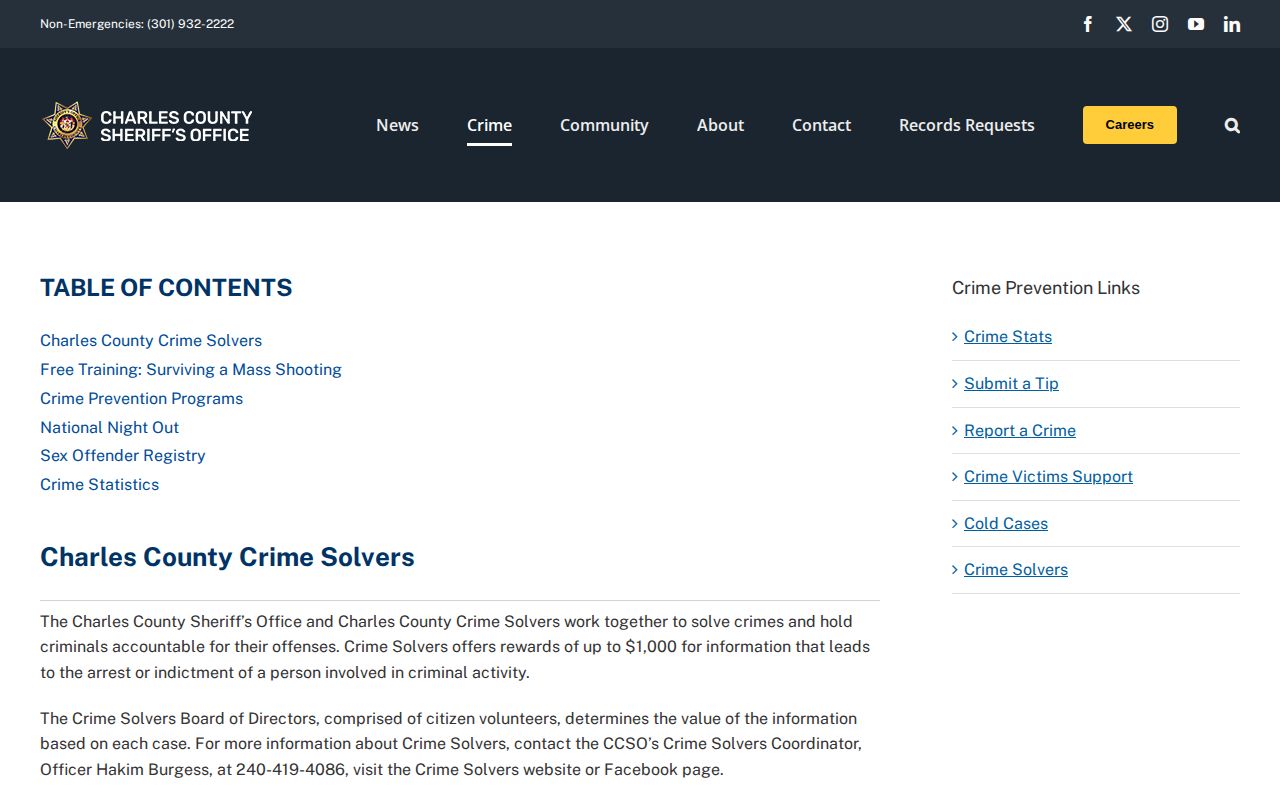
The map gives incident context. A call for service is not a booking. It may involve no arrest at all, and the official detention-center page explains the other half of that distinction.
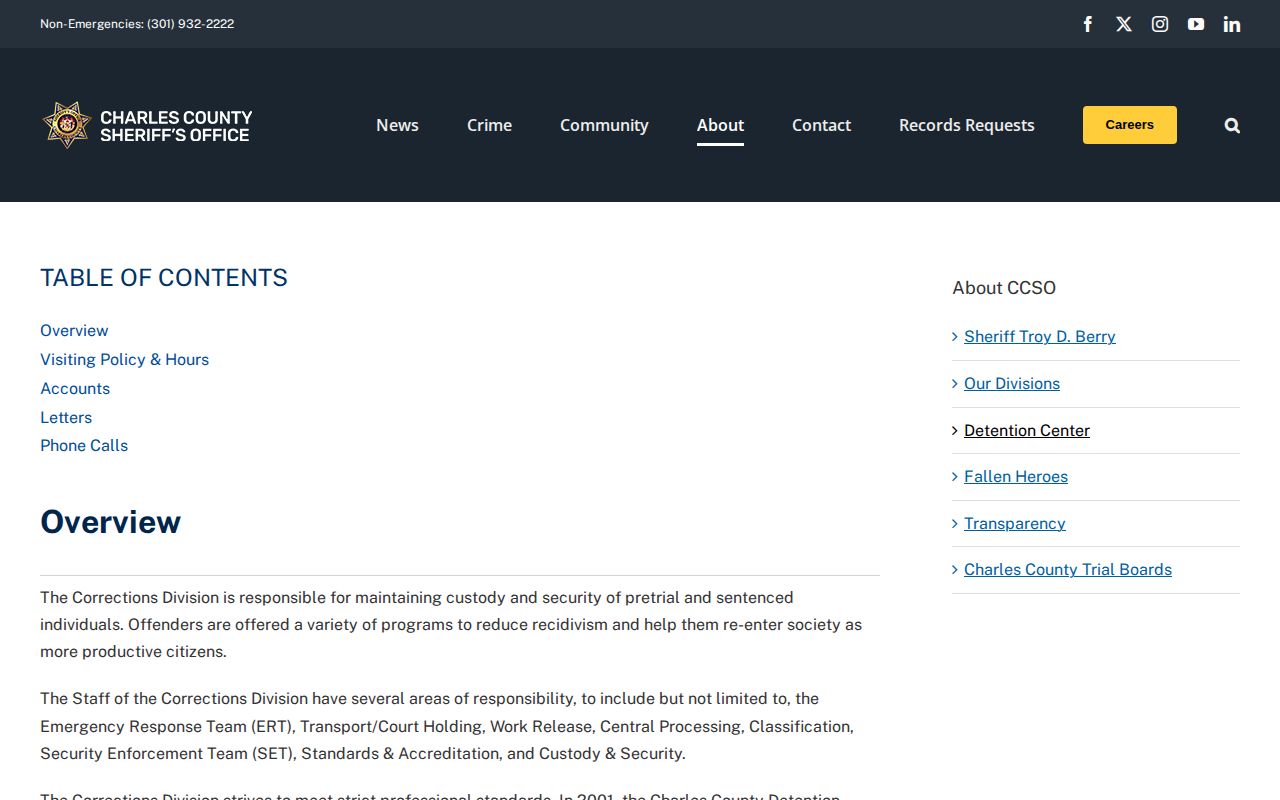
That facility page posts no multi-day roster. A person can be booked after a mapped event, released before a story runs, or charged by summons without detention-center intake. Keep calls, arrests, bookings, detention, and court cases separate.
News Reports Are Selective
Among local outlets, The BayNet Crime & Courts carries the steadiest crime stream. It covers CCSO, LPPD, Maryland State Police, and other agencies. Posts are event-driven. There is no guaranteed daily booking cutoff. The Charles County archive helps with geographic filtering, and the CCSO author archive shows when sheriff material drove a report.
Images need the same care as text. A story may show a handout photo or scene shot. That does not make it the official CCDC booking photograph. Its absence does not disprove an internal photo. Local reporting stays secondary to the originating agency and never forms a complete custody list.
Southern Maryland Headline News holds older regional sheriff reports and arrest stories. Use it for history. It offers no current CCDC feed and no consistent photo practice. Take a dated article only for what it states. Then verify with CCSO and the court.
Weekend Arrest Reporting Gaps
No Charles County weekend or holiday posting pattern exists because there is no official booking feed. Police work, central processing, public-information review, newsroom publication, and court filing all run on different clocks. A Monday article may describe a Friday event. A weekend intake may never get a press release. Search by the incident and arrest dates, not just the article date. Widen spelling and agency variations too. If the person is missing, call CCDC for current custody. Ask the likely arresting agency for a record. A missing story only means the outlets did not publish it. It does not disprove an arrest.
Older Charles County Arrest Records
Charles County booking photos and arrest records have no published shelf life at CCSO. Records Management handles storage, retention, retrieval, disposition, and expungement compliance. Online availability is a separate question from internal retention. A news story can outlive a person's custody. An agency file can survive after a public page vanishes. Even a copied article can linger after the court record itself has changed.
Make any request specific. Give the full name, the date range, and the arresting agency. Include the event or case number and the exact item you want. Ask which office holds the record now: CCSO, CCDC, LPPD, the clerk, or another custodian. For recent judicial material, start with Case Search or the Charles County clerk.
Older Charles County matters lead elsewhere. The Maryland State Archives Charles County guide describes permanent holdings there. Its Circuit Court Criminal Papers series T2663 holds original criminal-case papers. The papers cover listed years through 2012. That series is not a mugshot archive. Nothing indicates CCDC photos are transferred there on any routine basis.
- Archive
- A retained collection, not a statement of current custody.
- Roll-off
- The point when an entry leaves a temporary public display.
- Disposition
- The court’s final or later result.
- Shielding
- A legal process that limits public view of qualifying records.
Verify Weekly Arrest Allegations
Take every reported charge into the court system before drawing conclusions. A booking charge in Charles County can be reduced, dismissed, placed on a stet docket, resolved through probation before judgment, or end some other way. Maryland Judiciary Case Search shows filed events, but it excludes some juvenile, confidential, shielded, and expunged matters.
Keep the three layers straight. Current custody belongs with CCDC or covered VINE data. The agency record sits with CCSO or the arresting office. The legal outcome rests with the court. Sorting those apart gives a far more accurate weekly arrest picture than any list copied straight from the headlines.
Public Record Search
Sponsored Results